
My AI Legal Research Course, Open-Sourced
Two years of teaching AI-augmented legal research, now built into a free site at ailegalresearch.org

At SEAALL last month, I gave a talk called Designing for Change, a two-year account of teaching AI-Augmented Legal Research at Vanderbilt Law: what changed between iterations, what held up, and how the four skill areas the course is built on can be extracted and adapted for contexts that have nothing to do with a ten-week credit course. The room was full of people who do exactly that kind of training. When the talk ended, the question I kept hearing was some version of: where can I get the exercises?
My answer has always been: email me. In my last post on our Substack, I tried to share some of my exercises, but I was just sharing ideas, not the actual materials. So, every person who wanted to run the Anonymization Audit in their own 1L section, or adapt the Red Line Challenge for firm training, had to track me down individually and wait for a file! And I’ve been traveling, both for other conferences and fun (ask me sometime about all the elk and moose I saw in the Rockies last month!), so my response rate has been dismal. I have been my own bottleneck in something that should be able to move without me.
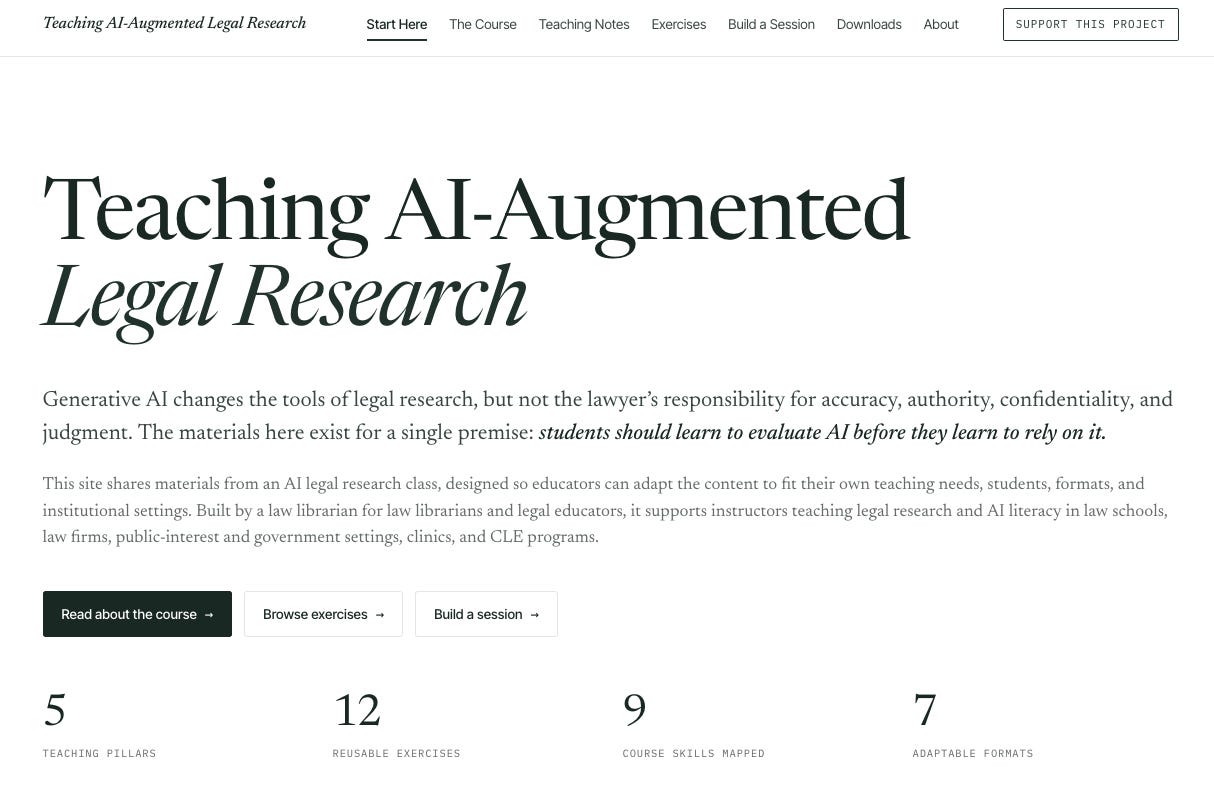
ailegalresearch.org/ is the answer.
Two Years, a Different Course
Let’s run it back for a sec: in Spring 2025, I taught AI Augmented Legal Research for the first time. VAILL pitched the course in Spring 2024, and a lot changed between then and course launch. You can read all about it in my Year 1 recap post.

Year 1 students were AI-curious but largely untested, and most exited the class a little let down by the tech and a bit pessimistic about the future of legal tech. We remind students that what they have access to right now is the worst it’ll ever be, but that’s little comfort to 3Ls graduating into their high-stress big law jobs.
Rather than write a whole diagnostic post this year, I’ll keep it short: the course had to be redesigned. This comes as no surprise to folks in the AI space: stuff I taught a year ago is basically prehistoric now, so the same course wouldn’t cut it a year later.
Too, the room had changed. Year 2 students were already using AI daily, for school and for their own work, and teaching them the Year 1 version would have felt like a waste of time for half the room.
With the materials of the Year 1 course loaded up in my Claude Cowork, I got to work rebuilding the course to be even more practice-oriented. I rebuilt the course around four durable skills: client data sanitization and privacy reasoning, AI as secondary sources and source evaluation, citation verification, and workflow documentation and professional judgment. Those four map onto ABA Formal Opinion 512 and the Model Rules. They hold up regardless of which tool happens to be on top this semester, and they are what I hear employers actually asking new associates to demonstrate.
Something to Riff On
Building a course like this from scratch is hard, and not in the way people usually mean when they say that. Ideas about teaching AI and the law are everywhere right now: every CLE description, every bar journal issue, every conference panel has one. And there are so many really excellent ideas out there; it is hard to keep up.
But the hard part was never the idea. It’s turning the idea into something you can actually run in a room full of people on a Tuesday afternoon: the structure, the materials, the pacing, the backup plan for when the technology does something nobody predicted halfway through.
I know that gap because I’ve spent two years standing in it, building this course twice (and retooling every week in prep for class and whatever tech drop landed). The second build went faster than the first, and not because I got smarter in twelve months. It went faster because I had something to start from: my own materials, my own notes on what worked and what didn’t, a shape I could adjust instead of inventing from nothing. Having something to riff on doesn’t hand you a finished course. It turns “how do I build this” into “how do I make this fit my students, my institution, my five-week intersession instead of my ten-week semester, etc.” which is a much easier question to answer.
That’s the gap ailegalresearch.org is built to close.
What’s in the Site
The site is organized around five teaching pillars that mirror the structure of the course itself: Foundations, Confidentiality and Ethics, Source-Specific Research, Drafting and Communication, and Verification and Workflow. It walks through the course I teach, and it houses an exercise and download library, a session builder, and a set of teaching notes.
I think there is a lot of cool stuff on the site, but the session builder is my favorite. It (and the site generally) is inspired by my mom. She taught math at a rural public school for decades, writing out her lesson plans and exercises by hand. She came from decades in the corporate sector, and while she could absolutely rock a presentation to the C-suite about the economics of X decision, she was in a new world with middle-schoolers learning basic algebra. She had the knowledge; she just needed to translate it for her audience.
When she and her colleagues got together to talk about their semester and year plans, they traded handwritten lesson plans and stories about what worked (and didn’t). They all spent nights and weekends (uncompensated!) to get where they needed to teach, without much more in resources than their own determination. I remember seeing stacks of papers and full binders in her office, wondering how on earth she kept track of which lesson plan went with which day, or which supporting materials belonged where. It felt like there was a wealth of information there, but how to share it or learn from it was limited to that medium.
While I can’t build her a lesson-plan generator for high school math (the joke about lawyers and math tracks for me too), I can build the equivalent for the community I actually teach in, so folks aren’t spending their nights and weekends starting from scratch. When I started teaching generally, I had sample syllabi, exercises, and colleagues’ help to get me started, but that’s not how it is for many educators. And if you’re teaching a new course like this, something that changes every day, it can very much feel like you’re in over your head before you get started.
You tell the builder what you have, whether that’s a CLE slot, a student orientation, an async training module, or a session for a specific practice group, and it assembles a structure you can actually run, pulling from exercises that fit the relevant pillar. Those exercises aren’t theoretical placeholders. Each one comes with setup instructions, instructor notes, and at least three adaptation paths for different institutional settings. Some are dressed-up versions of what I already run in my own classroom; a few are brand new, built for the site rather than tested live yet, and marked as such.
This first version is a little sparser than I wanted; my first mock up had minute-by-minute run-downs (which... never works out in a real teaching environment), so stay tuned for the next version to be built out even more. But what I’ve got now does what it needs to do: this tool helps you get a head start. Something that hands you a plan, a starting point, and sample materials to work from.
Where to Start
If you’re building a new course, start with the course arc and the teaching notes before the exercise library. The sequencing decisions are load-bearing, and the same exercise lands differently depending on where it sits in the arc. If you need a one-off session, go straight to the builder. If you’re looking for a single activity to drop into something you’re already teaching, the library filters by pillar, so you can quickly orient yourself.
I wrote last month about how exercises like these travel past the edges of a credit-bearing course, into firm trainings, CLEs, and other settings. That argument hasn’t changed. What’s different now is that you don’t have to take my word for it or wait for an email back. The site is the structure I was describing, built out and ready to use.

And I’m giving you everything I have so far, which might sound a little crazy. All this work, just out there for anyone? Yes!! I would rather hear about the Anonymization Audit running in a firm training in Tulsa, or in a workshop at another law school, than keep it running here, just for twenty students a semester in Nashville.
Because the course now runs every term, the site is a living document. New exercises and notes will go up as they’re built and tested. This is a working release, and I’m sure I got some things wrong in this first version.
I don’t have all the answers, and this is far from the only way to teach this material. But it’s one way, and I hope it’s useful to someone besides me. (It’s also, I suppose, my way of apologizing to everyone in my inbox I still owe a reply.)
Check it out. Better yet, do something with it and tell me about it!